Alarm bells are ringing over the debt binge financing our AI infrastructure. I share those concerns. Like every major innovation of the past several hundred years, AI will end up overcapitalized and eventually bust, while still delivering massive productivity gains. I'm an AI optimist and a financial realist. The two are not mutually exclusive.
This line from Monday's FT caught my eye:
"It also brings new risks. Chipmakers, data centre operators and their power providers are all borrowing from public and private credit markets as well as financing each other…[t]he interconnections between borrowers, in a new sector whose long-term trajectory is still unclear, have sparked concerns that if one falters, others could be dragged down with it."
The reporter is describing circular financing. The seller finances the buyer, the buyer's purchases show up as the seller's revenue, and demand looks stronger than it is. The risk is older than AI. It shows up in every cycle, most recently in the dot-com bubble and the Great Financial Crisis.
1999: Lend them the money
In the telecom boom, equipment makers lent customers the money to buy their equipment. Lucent gave Winstar up to $2 billion of financing to buy Lucent gear, and by September 2000 Lucent had $8.1 billion of customer financing commitments. Motorola went further with Iridium. It owned a quarter of the company, was its prime contractor and guaranteed $750 million of its bank debt.
The sales were real. Part of the money behind them was the seller's own. Iridium filed for bankruptcy in August 1999. Winstar filed in April 2001. Lucent took a $2.25 billion provision against its customer financing that fiscal year.
2007: The machine bought itself
The mortgage boom ran the same play through more layers. Mortgage bonds funded the loans, CDOs funded the mortgage bonds, and then CDOs started funding each other. By 2007, other CDOs were buying the majority of the riskier CDO slices. Banks kept the top slices, insured some with AIG, and moved more assets into off-balance-sheet vehicles they stood behind. In December 2007, Citigroup took $49 billion of those vehicles' assets onto its balance sheet.
Much of the demand for subprime came from the machine itself. In March 2007, Fed Chair Ben Bernanke told Congress the damage "seems likely to be contained." Deal by deal, it looked that way. I worked at Merrill Lynch at the time. The risks were anything but contained.
2026: Both playbooks at once
AI runs both. NVIDIA committed $30 billion to OpenAI this spring and now offers to backstop part of its customers' chip financing. Microsoft owns about a quarter of OpenAI and booked $24.1 billion of revenue from it last fiscal year. OpenAI's $300 billion compute contract is close to half of Oracle's $664 billion backlog. The supplier funds the customer, the customer leases from the developer, and the developer borrows against the customer's lease.
The off-balance-sheet layer is back too. Meta financed its Hyperion data center in Louisiana through Beignet, a vehicle it owns 20% of alongside Blue Owl. Beignet's $27 billion of bonds pay at least 100 basis points more than Meta would have paid, and the debt stays off Meta's balance sheet. Moody's counts about $970 billion of lease commitments at the five largest hyperscalers, $660 billion of it for leases not yet on their balance sheets.
And this circle is the biggest yet. Stijn Van Nieuwerburgh's new Brookings paper puts the US AI buildout at about $10.3 trillion over 2025 to 2032, roughly 3.6% of GDP a year. The telecom boom Lucent was financing ran about 1.1% of GDP a year.
Bulls argue AI is a step-function jump in growth. Demand is insatiable, and the Jevons paradox says falling costs will only widen adoption. I agree AI may change lives for the better. So did railroads and fiber, and both still went through a bust.
Why the circle makes it worse
Circular finance does three things, every time. It inflates demand, because part of each sale is the seller's own money. It concentrates risk, because balance sheets that look independent hold the same bet. It hides obligations in guarantees, vehicles and commitments outside the headline numbers. When the money stops, the links fail together.
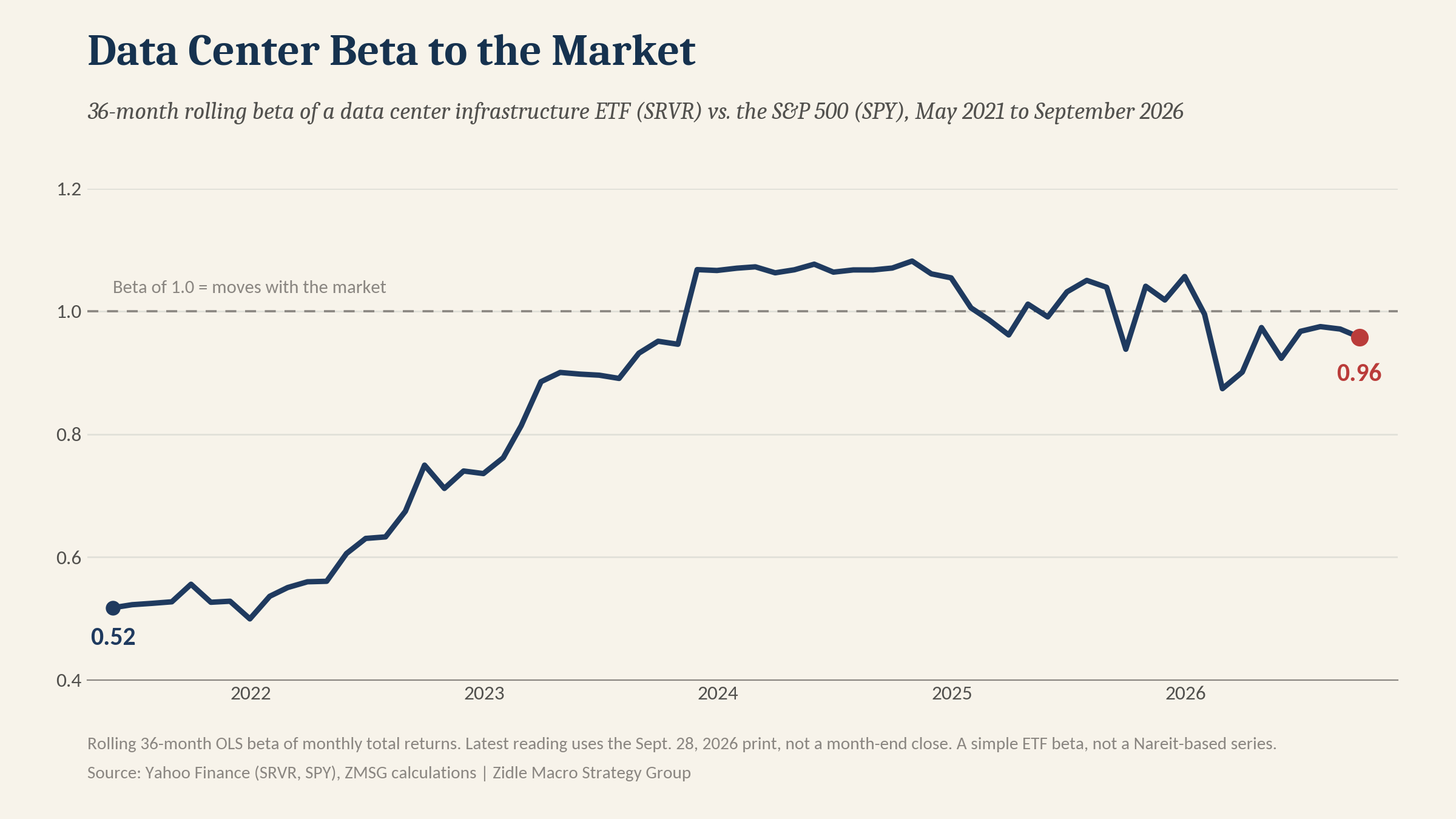
The market has started pricing that. The beta of data center REITs has roughly doubled, from about 0.5 to around 1. Long priced as defensive infrastructure, they now trade like the rest of the AI complex. Beignet's bonds have fallen from 110 cents on the dollar to a record low near 94 last week.
Watch the funding
None of this means the bust is here. A circle holds as long as new money keeps coming in, the lesson Winstar learned. By Van Nieuwerburgh's math, at a 10% unlevered return and 50% operating margins, the buildout needs about $3.7 trillion of annual revenue by 2032, roughly 9% of GDP. Until that revenue shows up, this is a machine that has to keep raising money. Rising yields and falling equity prices while the bills keep coming is the combination to watch.
What I would do
I've asked Grok Bot to build a "canary in the coal mine" indicator. Will it help? When the canary in the coal mine dies, it is no longer the canary's problem. It is ours.
So I would position before the warning arrives. Every boom pulls capital toward the winners and starves everything else. What gets starved is what I call unloved: cheap, ignored and owned by few. The history of unloved assets is a good one. After the tech bubble burst, the next bull market started in West Texas. Oil, left for dead near $10 a barrel in 1998, touched $147 in July 2008. The Nasdaq needed 15 years to recover its March 2000 peak, and in early 2008 it still traded below half that level.
Today's list starts with long-duration Treasuries, which may be the most unloved asset in the world right now. The 30-year yields about 5.5%, the highest since 2004, 10-year Treasuries yield 5.2%, the highest in nearly 20 years. They are a hedge against a growth scare not against an inflation shock, so I would build the position in pieces.
Own high-quality cash flows and value. Balance sheet strength and earnings stability will matter.
Add uncorrelated cash flows: reinsurance and catastrophe bonds, mineral and royalty interests, farmland and timber, regulated water utilities. Hurricanes, crop yields and water bills do not care about AI funding conditions.
Be picky in private credit. Favor asset-backed and specialty finance. Ask every manager how much sits in data center lending, and how much in direct loans to software companies that AI itself may disrupt.
I remain bullish on AI. The technology will outlast the financing, as it did with railroads and fiber. The only question is where you are standing when the circle stops spinning.
Sources: NVIDIA, Axios, Financial Times, Lucent, Winstar and Iridium SEC filings, Washington Technology, Financial Crisis Inquiry Commission, ProPublica, CNN, Federal Reserve, Microsoft FY2026 Form 10-K, Oracle, Wall Street Journal, CNBC, Moody's Ratings, Brookings, FASB
IMPORTANT DISCLOSURES
Zidle Macro Strategy Group is an independent macroeconomic research and commentary service. The content in this publication is informational and analytical in nature and does not constitute investment advice, a solicitation, or an offer to buy or sell any security or investment product. ZidleMSG is not a registered investment adviser, broker-dealer, or fiduciary under any federal or state securities law.
This publication does not recommend, endorse, or make any specific buy, sell, or hold recommendation for any security, ETF, mutual fund, private fund, or other investment vehicle. Any companies, individuals, or projects referenced are discussed solely for analytical and illustrative purposes. ZidleMSG has no financial relationship with, and receives no compensation from, any entity mentioned in this publication.
All commentary represents the views of the author based on publicly available information and macroeconomic analysis. Such views are subject to change without notice. Past commentary does not constitute a performance track record, and no representation is made that any analysis or forward-looking view will prove accurate.
Investing involves risk, including the possible loss of principal. Readers should conduct their own independent research and consult a qualified financial, legal, or tax professional before making any investment decision. ZidleMSG assumes no liability for any investment decisions made in reliance on this content.
© Zidle Macro Strategy Group. All rights reserved. Reproduction or redistribution of this content, in whole or in part, is prohibited without the prior written permission of ZidleMSG.