Oil sold off hard last week on hopes of a breakthrough with Iran over the Strait of Hormuz. WTI fell from above $100 to about $90 by Tuesday. It is back near $95 today, after Tehran said it would keep restricting passage through the Strait while U.S. sanctions stay in place. The relief took a week to build and two sessions to start unwinding. The bigger story came out yesterday: U.S. factories are running stronger for longer.
Inflation is only partly an oil story. Oil drives the cost-push when it runs hot, and energy CPI is still up 16% from a year ago. Strip out food and energy entirely, though, and core PCE is still 3.3%. The rest is demand: high-income spending, a labor market that refuses to loosen, and a factory sector that just reaccelerated. None of that is contingent on Hormuz.
THE FACTORIES WOKE UP
The flash S&P Global manufacturing PMI jumped to 57.0 in September from 53.9, against a consensus near 53.6. That is the strongest reading since May 2022. New orders grew at their fastest pace in nearly four and a half years, and factory hiring at its fastest since February 2021. Companies don't hire people they don't need.
Watch supplier delivery times, which stretched the most since July 2022. Slower deliveries are a leading indicator. They tell you the pipeline is full before the output shows up, which is why the index counts them as strength. Some of this is precautionary because of the Gulf disruption, and I grant a piece of it. But deliveries slowing alongside the strongest orders in four and a half years is demand pulling on supply. That sets up the next several months of activity, and it is how cost pressure stays sticky.
NOBODY IS LETTING GO
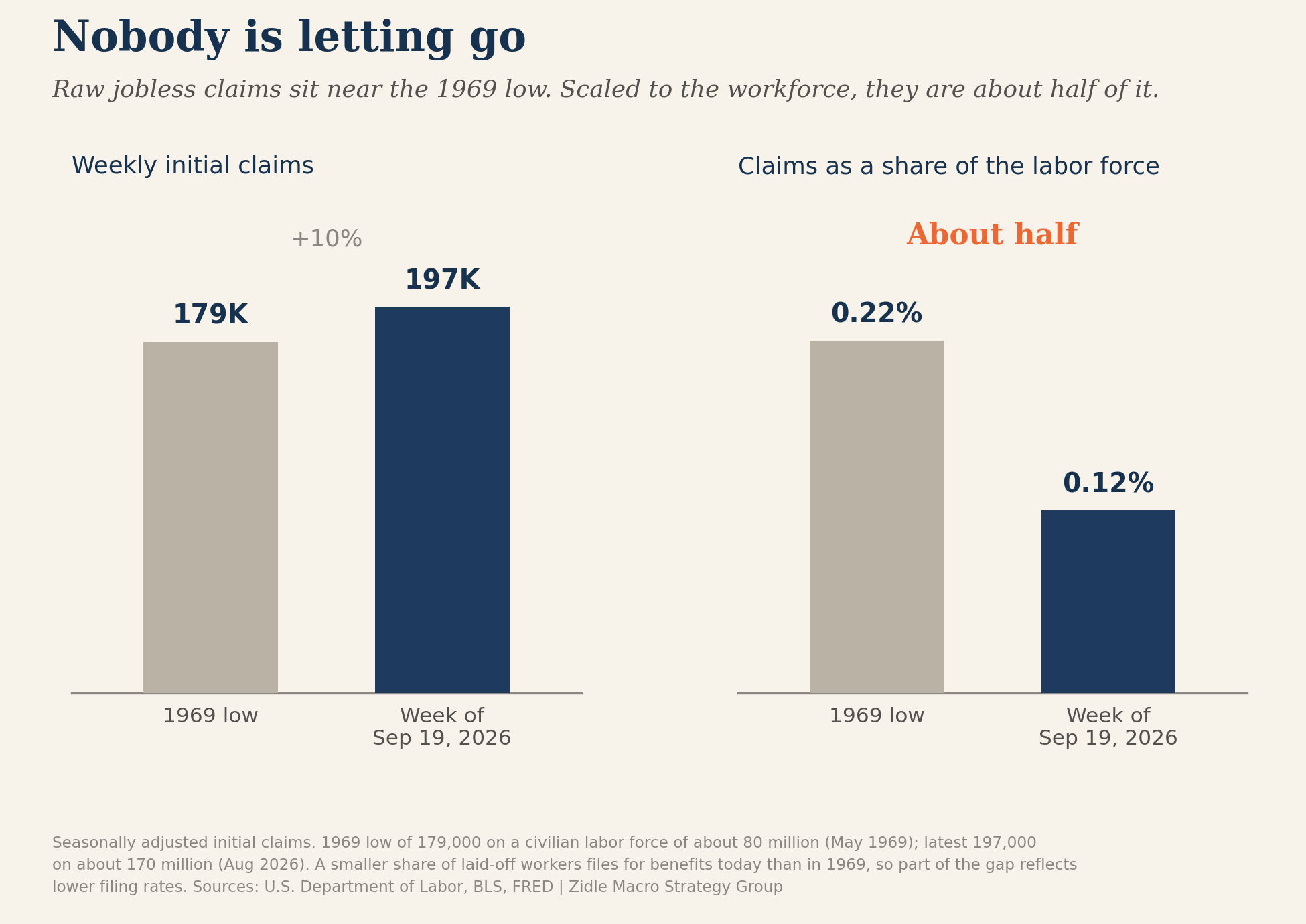
The layoff data says it louder. Initial jobless claims came in at 197,000 this morning, within 10,000 of July's low, which was the lowest since 1969. The labor force was about 80 million in 1969 and is about 170 million today. Scaled to the size of the workforce, today's claims are about half the layoff intensity of the 1969 low. Payroll growth, meanwhile, has run a modest 71,000 a month over the last three months. Companies are holding onto workers they could let go, and firms hoard labor when they expect demand.
A PERMISSION SLIP
The Fed raised rates a quarter point last week to 3.75–4.00%, its first hike since 2023. The median dot shows one more this year. Against core PCE of 3.3%, the real policy rate is a little over half a point. That is a permission slip for an economy that wants to run hot.
The long end tells the same story from the other side. Treasury has made clear it will lean against rising long yields. They have climbed anyway, and I expect Treasury to lean harder. A higher policy rate with a capped long end seems incongruous. Meanwhile 10-year breakevens around 2.34% looks complacent for this data.
WHERE I WANT TO BE
The Fed has to hike at least twice more from here, and my base case is three more over the next twelve months. The median dot's single additional hike understates the job if core stays above 3%, factories keep reaccelerating and companies keep holding onto workers. Stronger for longer argues for more restriction, and sooner.
In public markets, I lead with energy and oil services and add materials and commodities. I prefer TIPS and breakevens over long nominal duration, and floating-rate credit over fixed.
In private markets: energy, real assets, inflation-linked infrastructure and floating-rate private credit. Match the cash flows to the inflation you have.
The point is to own the nominal side of the U.S. economy. A softer oil screen changes none of what is doing the work: core above 3%, layoffs at half their 1969 intensity, a real policy rate still near half a point, and a 57-handle PMI.
Oil is the headline. The factories are the story.
Sources: S&P Global flash PMI via Trading Economics, U.S. Department of Labor, BLS, BEA, Federal Reserve Board, FRED
IMPORTANT DISCLOSURES
Zidle Macro Strategy Group is an independent macroeconomic research and commentary service. The content in this publication is informational and analytical in nature and does not constitute investment advice, a solicitation, or an offer to buy or sell any security or investment product. ZidleMSG is not a registered investment adviser, broker-dealer, or fiduciary under any federal or state securities law.
This publication does not recommend, endorse, or make any specific buy, sell, or hold recommendation for any security, ETF, mutual fund, private fund, or other investment vehicle. Any companies, individuals, or projects referenced are discussed solely for analytical and illustrative purposes. ZidleMSG has no financial relationship with, and receives no compensation from, any entity mentioned in this publication.
All commentary represents the views of the author based on publicly available information and macroeconomic analysis. Such views are subject to change without notice. Past commentary does not constitute a performance track record, and no representation is made that any analysis or forward-looking view will prove accurate.
Investing involves risk, including the possible loss of principal. Readers should conduct their own independent research and consult a qualified financial, legal, or tax professional before making any investment decision. ZidleMSG assumes no liability for any investment decisions made in reliance on this content.
© Zidle Macro Strategy Group. All rights reserved. Reproduction or redistribution of this content, in whole or in part, is prohibited without the prior written permission of ZidleMSG.