Pepper, my three-year-old Cavalier King Charles spaniel, cannot tell you which of us is smarter, my wife or me. There is a difference (my wife is ABD, all but dissertation; I am all but done arguing the point). It sits beyond Pepper's ability to evaluate, and in fairness to her, her grading system has only ever had one criterion: who is holding the treats.
In the age of superintelligence, we may all become the dog.
The AI debate tends to start in the same place. How much smarter will the models get? Who builds the best one? Who wins the race to superintelligence?
I would ask a different question. At some point, does smarter stop mattering?
That sounds premature. Today the gap between the best model and the fifth-best still matters a great deal. But carry the trajectory forward another 12 months. Picture a system far more capable than the best mathematician, scientist, programmer, physician and strategist who has ever lived. Then make it smarter still.
THE PEPPER PROBLEM
Imagine one model with the equivalent of a 350 IQ and another at 400. The technical difference may be real. But if neither you nor I can follow either model's reasoning, measure the gap between them, or name a problem worth paying for that one can solve and the other cannot, what are the extra 50 points worth?
Possibly a lot less than they cost to build.
THE UTILITY CURVE BENDS
The case behind the buildout rests on two links. More compute produces more intelligence. More intelligence produces more economic value.
The first link may keep holding. The second may not.
Early gains in capability are enormously valuable. A model that goes from unreliable to useful opens whole categories of work. But once a model can do nearly every intellectual task a person reasonably asks of it, further gains can be a remarkable technical achievement and still produce little change in what anyone will pay.
The capability curve keeps rising. The utility curve starts to flatten.
If several systems can solve essentially every problem a company hands them, the customer stops caring that one is 15% smarter and starts caring about cost, speed, reliability, security, integration, availability and distribution.
At that point intelligence starts to look less like a product and more like a utility. It could become indispensable. Indispensable is one thing. Profitable is another.
THE CURVE IS ALREADY BENDING
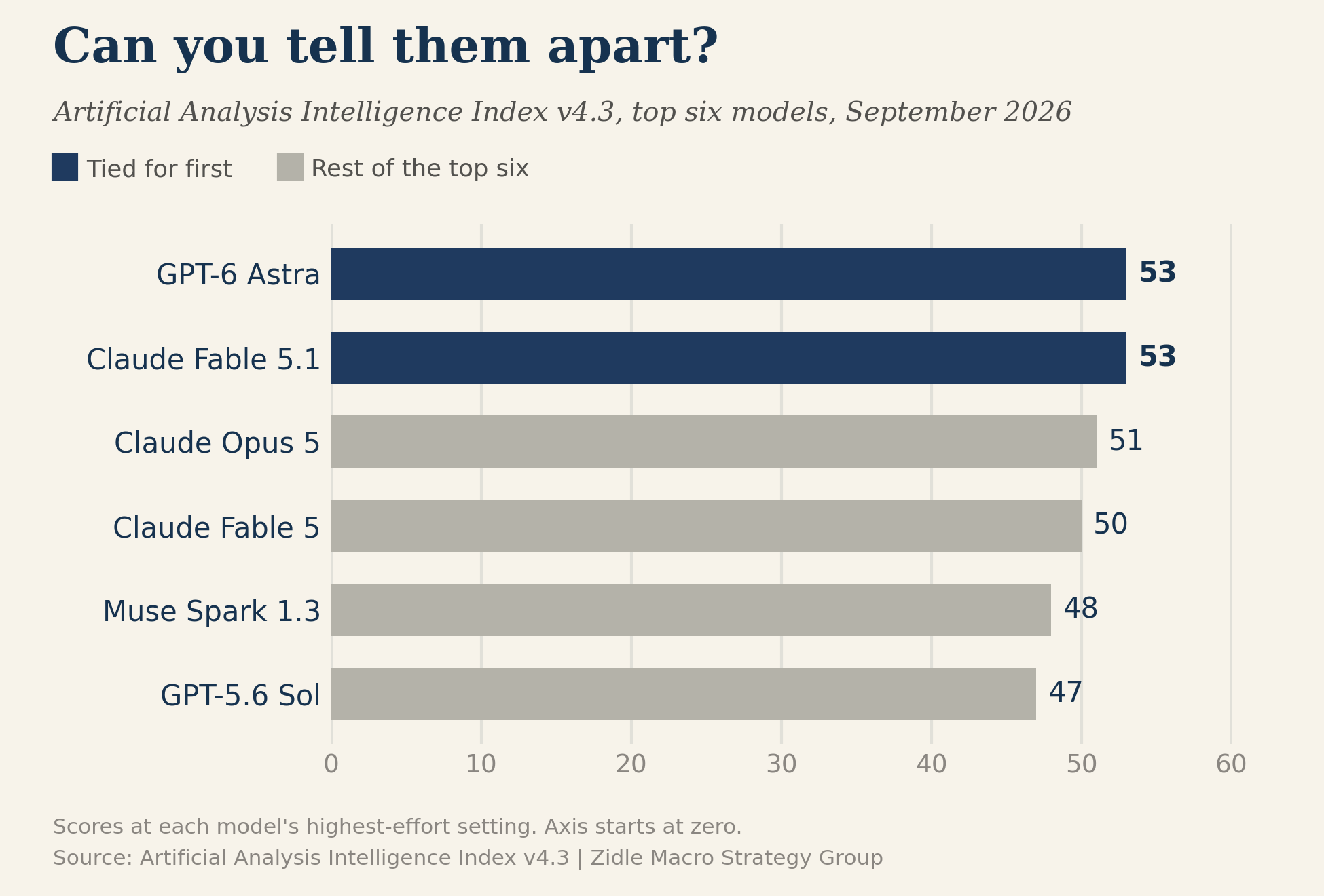
OpenAI released GPT-6 Astra on September 3, the product of the largest training run in its history. My best estimate for Astra's final training run is about $1 billion. Within days, Artificial Analysis scored it at 53 on its Intelligence Index, a dead tie with Anthropic's Fable 5.1. The two best models in the world billions of dollars in R&D, and the leading independent scorekeeper cannot separate them. Pepper would recognize the problem.
Customers are acting accordingly. On Vercel's AI gateway, open-weight models ran 56% of all tokens in August, up from 7% in December, while taking 14 cents of every dollar spent. The average price per token fell 23% in August alone. Buyers are trading down even inside a single lab: when Anthropic launched a model at half the price of its best one, nine in ten teams using the top model cut back. Vercel's verdict: the extra capability was not worth double the price.
THE CAPITAL TRAP
The capital is being deployed on the opposite assumption. Microsoft, Alphabet, Amazon and Meta will spend roughly $730 billion on capital projects this year, and consensus has the same four near $935 billion in 2027. Much of that capacity is being built for two tenants. OpenAI expects to spend about $50 billion on compute this year against internal revenue targets near $30 billion, and plans roughly $750 billion through 2030. Anthropic signed up to $517 billion of multi-year compute commitments in the eleven months to August alone.
All of it rests on a single bet: that more intelligence will stay scarce enough, differentiated enough and valuable enough to justify what it costs to produce.
If intelligence commoditizes instead, spending keeps rising while the return on the output falls. The models get better. The economics get worse. That is the AI capital trap.
The private market is pricing the bet as settled. OpenAI raised at $852 billion in March and is reportedly in talks at $1.2 trillion. Anthropic was valued at $965 billion in June, and it is reported to be targeting about $2 trillion in its IPO. On their latest reported run rates, the two bring in about $105 billion a year between them. That is roughly 17 times revenue at the last private marks and about 30 times at the numbers now being floated. Those multiples are the price of scarcity, and if the Pepper Problem is right, scarcity is the assumption most exposed.
THE LAST MODEL
Followed to its end, the argument says the world may need far fewer independently trained frontier models than the capital assumes.
There will be more than one. Governments will want sovereign systems, companies will want redundancy and competition will keep alternatives alive.
But applications and frontier intelligence are separate markets. The world may need thousands of AI applications. It probably does not need thousands of independently trained superintelligences.
There will be winners building the intelligence itself, just far fewer than the capital chasing them assumes.
FOLLOW THE SCARCITY, CAREFULLY
If intelligence becomes abundant, where does scarcity remain? The consensus answer is the picks and shovels of AI: semiconductors, power, data centers and private infrastructure.
That trade carries a risk its owners did not intend. The two tenants pay with money raised on the assumption that intelligence stays scarce, and Moody's says the hyperscalers added roughly $700 billion of contracted backlog in two quarters, much of it from those two. Scarcity that depends on the model layer paying its bills is really credit exposure to the model layer.
So the picks and shovels split in two. Chips and data-center shells are short today because buyers are spending as if intelligence will stay scarce. Build enough of them and they stop being scarce. The physical bottlenecks are different. A superintelligent system can write extraordinary software. It cannot conjure a transmission line, manufacture transformers on demand or create power where there is no generation. Those shortages take years to fix and serve the whole economy, frontier lab or not. Power belongs in this group only where it serves the grid rather than a single tenant.
The last cycle ran exactly this way. The fiber laid in the late 1990s was real, and it did not save Global Crossing or Lucent. The builders lost. What they left behind was bandwidth so cheap it was nearly free, and YouTube, streaming video and the cloud all grew up on capacity someone else had overpaid for.
That is where I would look this time. The biggest winners of cheap intelligence may be the companies that build on it rather than make it, folding a nearly free input into products and customer relationships they already own, as long as they can hold their price. Every time a token gets cheaper, so do their costs.
The smartest model might not own the best business. Neither might the company selling it shovels. The best business may belong to the customer.
THE CALL
The question I would put to any AI allocation is where scarcity survives once intelligence is abundant.
If capability converges while the cost of access keeps falling, much of the capital pouring into the model layer will struggle to earn the returns it was underwritten to. The winners may sit in the physical bottlenecks and in the companies that turn cheap intelligence into better products and fatter margins. Much of the rest of the infrastructure trade is a claim on the same bet.
The real bear case is an AI so smart that getting smarter stops mattering. The industry could succeed beyond anyone's imagination and still disappoint the people paying for it.
Pepper figured this out early. She has never cared which of us is smarter, only who fills the bowl. Customers may land in the same place, and the end state of AI may look less like the software monopolies and more like electricity: enormously valuable, universally consumed and increasingly hard to tell apart.
Sources: Artificial Analysis, Vercel, Epoch AI, Moody's Ratings, MarketScreener, The Information, The Wall Street Journal, Bloomberg, Financial Times, Reuters, company filings and guidance.
IMPORTANT DISCLOSURES
Zidle Macro Strategy Group is an independent macroeconomic research and commentary service. The content in this publication is informational and analytical in nature and does not constitute investment advice, a solicitation, or an offer to buy or sell any security or investment product. ZidleMSG is not a registered investment adviser, broker-dealer, or fiduciary under any federal or state securities law.
This publication does not recommend, endorse, or make any specific buy, sell, or hold recommendation for any security, ETF, mutual fund, private fund, or other investment vehicle. Any companies, individuals, or projects referenced are discussed solely for analytical and illustrative purposes. ZidleMSG has no financial relationship with, and receives no compensation from, any entity mentioned in this publication.
All commentary represents the views of the author based on publicly available information and macroeconomic analysis. Such views are subject to change without notice. Past commentary does not constitute a performance track record, and no representation is made that any analysis or forward-looking view will prove accurate.
Investing involves risk, including the possible loss of principal. Readers should conduct their own independent research and consult a qualified financial, legal, or tax professional before making any investment decision. ZidleMSG assumes no liability for any investment decisions made in reliance on this content.
© Zidle Macro Strategy Group. All rights reserved. Reproduction or redistribution of this content, in whole or in part, is prohibited without the prior written permission of ZidleMSG.