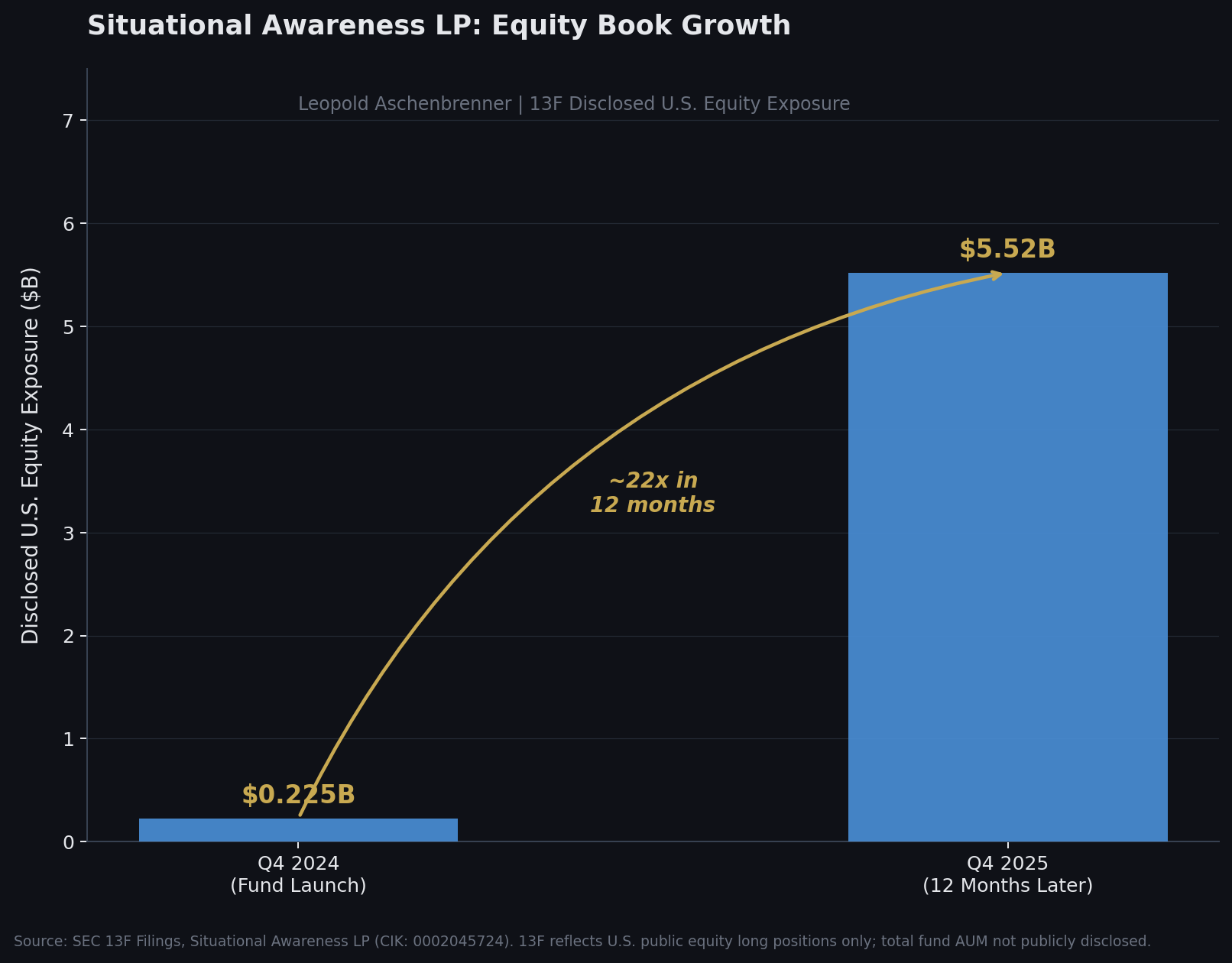
Two things have been rattling around in my head, and a third one I can't quite square. Leopold Aschenbrenner, the former OpenAI researcher who graduated Columbia valedictorian at 19, and whose "Situational Awareness" essay became required reading across institutional finance, grew his disclosed equity book from $225 million to $5.5 billion in twelve months. Then his Q1 2026 13F landed: $13.7 billion in total portfolio exposure, with $8.46 billion of that in put notional across AI and semiconductor names. The true believer is hedging.
Meanwhile, the S&P 500 just posted its best two-month return in 70 years of data across May and June. Euphoria is building.
And then there's this: the 10-year Treasury yield moved from 4.3% on April 1 to 4.5% on June 1. Over that same stretch, consensus shifted from pricing rate cuts to pricing a rate hike, and oil remained elevated. Risk assets ripped anyway. The bond market is telling one story. Equities are telling another. I don't know how to reconcile those two things, and I'm suspicious of anyone who says they can.
The bull case isn't wrong. Unemployment sits at 4.3%. Initial claims at 215,000. JOLTS openings at 6,866,000. The economy is still running and the cyclical bull is intact. I'm not arguing otherwise. But the valuation picture is in a completely different place.
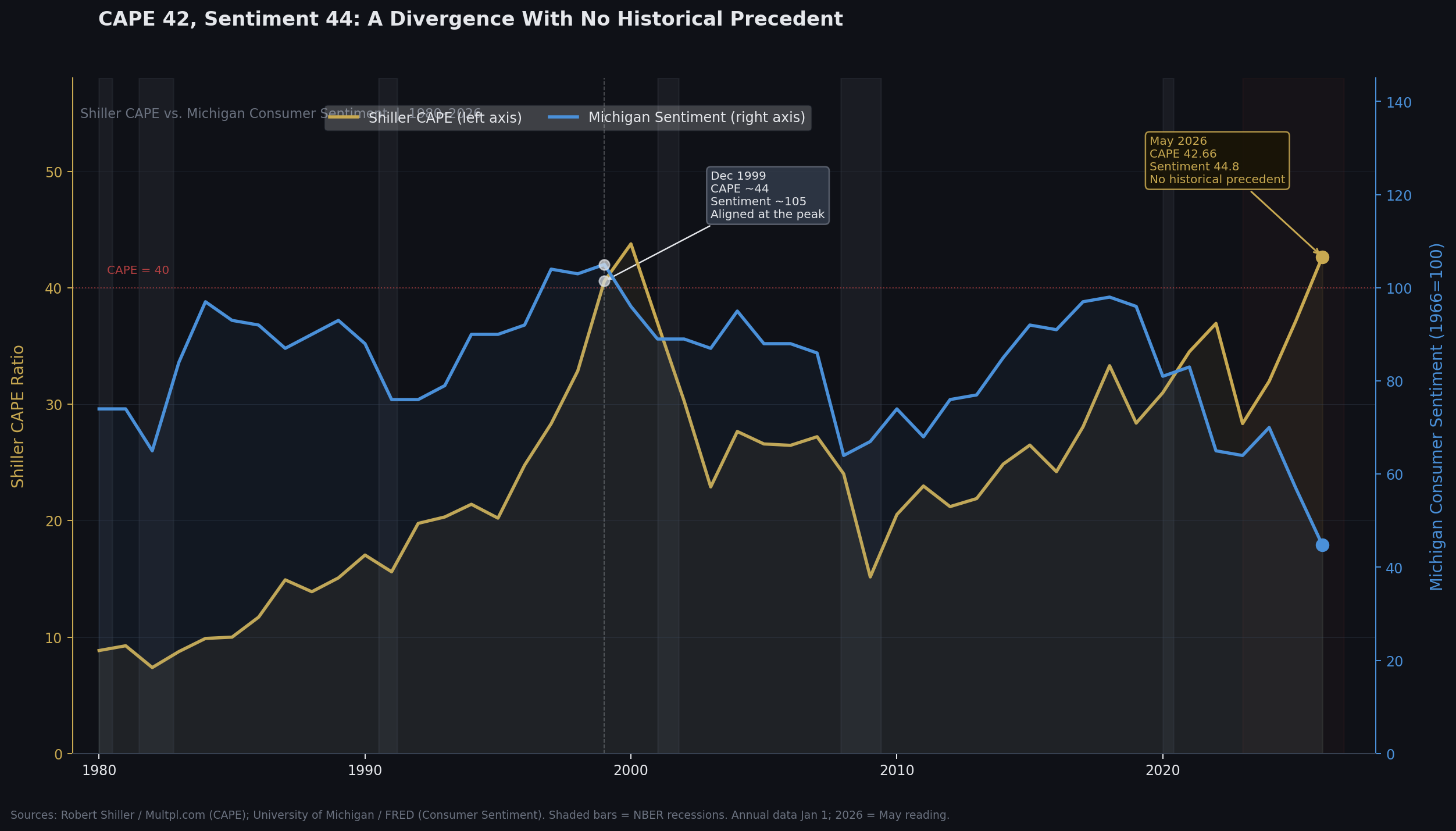
Shiller CAPE stands at 42.66, the second-highest reading in 145 years, exceeded only by December 1999's 44.19. S&P 500 forward P/E is 22.8x NTM. By the measure that has historically preceded every major cycle peak, we are at the doorstep of the only prior extreme on record. CAPE doesn't tell you when; it tells you where you stand.
Michigan Consumer Sentiment fell to 44.8 in May 2026, a new all-time low in 70-plus years of the survey. I know the counterargument: post-2016 partisan dynamics explain some of this, and the hard labor data isn't confirming distress. Fine. But in 145 years of Shiller data, CAPE has never exceeded 40 while sentiment was this depressed. When CAPE last approached current levels in December 1999, Sentiment stood near 105, among the highest readings in the survey's history. That alignment does not exist today.
Financial markets are priced as if nothing can go wrong. VIX at 15.74. High-yield spreads at 2.72%, bottom decile historically. Investment-grade spreads at 0.73%. Credit and volatility have collectively decided risk is absent. The wall of worry has been climbed and forgotten.
The strongest counter is the AI productivity repricing thesis. If AGI arrives between 2027 and 2029, as Aschenbrenner's own published framework posits, a CAPE of 42 may ultimately prove cheap. I take that seriously. But even if AI delivers the step-change, diversification is warranted, because the risk is in the path, not the destination. Aschenbrenner's disclosed put notional on chip stocks is exactly that acknowledgment: a hedge not against the AI thesis, but against the multiple compression between here and there. How we get to the good outcome matters as much as the outcome itself.
Monetary conditions add a structural layer. M2 grew 4.7% year-over-year, re-accelerating while CPI runs at 3.78% and core PCE at 3.29%. The traditional backstop is compromised. Accelerating inflation means if growth slows, the cavalry arrives with limited options.
Two things would materially weaken this thesis: S&P 500 forward P/E contracting below 18x within 12 months, or Michigan Consumer Sentiment recovering above 70. Either would indicate the divergence is resolving rather than deferring.
I'm not calling the top. The cyclical bull is intact. But I see the bill being written.
The positioning answer isn't to avoid equities. It's to stop depending on them to do all the work.
At CAPE 42, public equity returns require either substantial earnings growth or multiple expansion. Earnings growth is plausible. Multiple expansion from here is a tough ask. So the question becomes: where else can capital earn a real return without that dependency?
Private credit is the clearest answer right now. Senior secured, first-lien, floating rate, with inflation step-ups baked into the docs. You're getting paid to wait at spreads public markets can't touch. Infrastructure is the other one: contracted cash flows, CPI linkage, long duration. It's the asset class specifically designed for the scenario where growth slows and inflation doesn't, which is exactly the scenario that would do the most damage to a public equity portfolio.
Real estate is more selective. Essential-use, supply-constrained, inflation-indexed. Look critically at anything with a refinancing wall before 2028.
Private equity gets a narrower mandate: operational businesses where the return comes from cash generation and margin improvement, not from buying cheap and selling into a richer multiple. That last part is the risk. At current public market valuations, the exit re-rating trade is uninvestable.
The illiquidity premium is real, but vintage entry is everything. The data on this is actually striking: across 30 years of cycles, the worst PE vintage entered at cheap public market valuations still outperformed the best vintage entered at rich ones. PitchBook puts the best-to-worst spread at 400 to 600 basis points of net IRR over 15 years. The mechanism is simple: private entry multiples follow public ones down, and what you pay at entry is the one variable you actually control.
Fresh capital, deployed patiently across these asset classes over the next three to five years, has a credible path to outperforming a late-cycle public equity allocation. Current-mark PE and VC is a separate conversation: stale NAVs and late-cycle entry risk are real, and that exposure deserves its own review.
Sources: Pitchbook, Cambridge Associates, Preqin, FMP, AlphaVantage and St. Louis Federal Reserve.
IMPORTANT DISCLOSURES
Zidle Macro Strategy Group is an independent macroeconomic research and commentary service. The content in this publication is informational and analytical in nature and does not constitute investment advice, a solicitation, or an offer to buy or sell any security or investment product. ZidleMSG is not a registered investment adviser, broker-dealer, or fiduciary under any federal or state securities law.
This publication does not recommend, endorse, or make any specific buy, sell, or hold recommendation for any security, ETF, mutual fund, private fund, or other investment vehicle. Any companies, individuals, or projects referenced are discussed solely for analytical and illustrative purposes. ZidleMSG has no financial relationship with, and receives no compensation from, any entity mentioned in this publication.
All commentary represents the views of the author based on publicly available information and macroeconomic analysis. Such views are subject to change without notice. Past commentary does not constitute a performance track record, and no representation is made that any analysis or forward-looking view will prove accurate.
Investing involves risk, including the possible loss of principal. Readers should conduct their own independent research and consult a qualified financial, legal, or tax professional before making any investment decision. ZidleMSG assumes no liability for any investment decisions made in reliance on this content.
© Zidle Macro Strategy Group. All rights reserved. Reproduction or redistribution of this content, in whole or in part, is prohibited without the prior written permission of ZidleMSG.